 seolounge

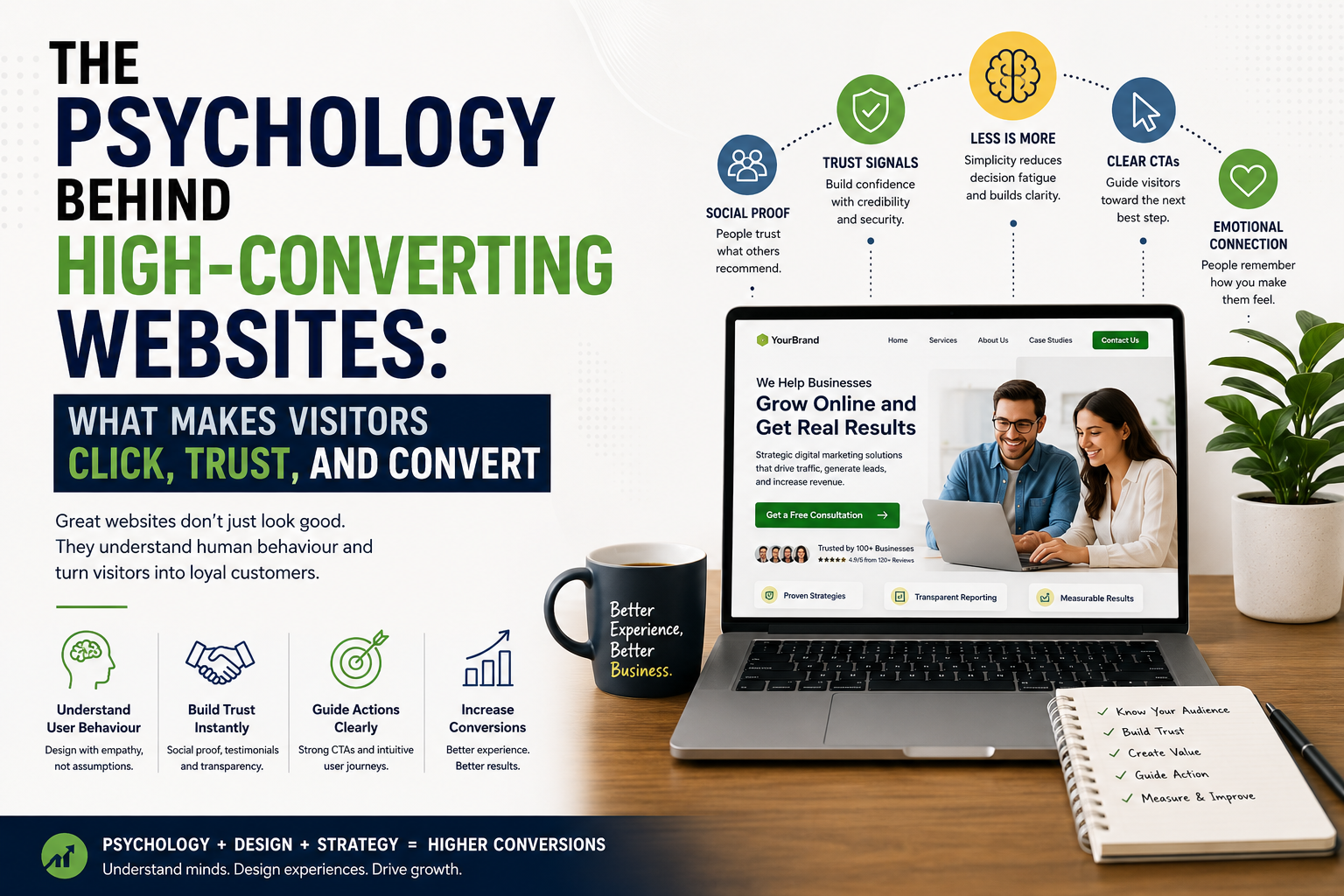
Imagine walking into a beautifully designed store where you can’t find what you’re looking for, no one greets you, and the checkout counter is hidden in the back. Chances are, you’d leave within minutes.
The same thing happens online.
Your website may have an attractive design, rank well on Google, and attract thousands of visitors every month—but if it doesn’t build trust or guide visitors towards taking action, those visits won’t translate into enquiries or sales.
This is where website psychology plays a crucial role.
While search rankings and website traffic are important, they don’t always guarantee business growth. In fact, many businesses invest heavily in SEO or paid advertising only to discover that visitors still aren’t converting into customers. If you’ve already explored our guide on Why Your Google Ads Are Not Converting (And What You Can Do About It), you’ll know that attracting traffic is only half the battle—the real challenge is convincing visitors to take action once they arrive on your website.
High-converting websites aren’t just visually appealing; they’re strategically designed to influence how people think, feel, and make decisions. By understanding what motivates users, businesses can create experiences that encourage visitors to click, engage, and ultimately convert.
Why Psychology Matters in Website Design
People don’t always make logical decisions—they make emotional ones first and justify them with logic later.
According to the Nielsen Norman Group, users often form an impression of a website within seconds. If the design feels confusing, cluttered, or untrustworthy, many visitors leave before exploring further.
This means your website isn’t just representing your business—it’s shaping the first impression of your brand.
The Key Psychological Principles Behind High-Converting Websites
1. First Impressions Count
Your homepage should immediately answer three simple questions:
- Who are you?
- What do you offer?
- Why should someone trust you?
If visitors have to search for these answers, there’s a high chance they’ll leave.
A clear headline, supporting text, and a visible call-to-action (CTA) help visitors understand your value proposition instantly.
Example:
Instead of:
We Deliver Innovative Digital Solutions
Use:
Grow Your Business with SEO, Google Ads & Website Development That Delivers Real Results
The second version is specific, benefits-driven, and easier to understand.
2. Simplicity Reduces Decision Fatigue
Have you ever visited a website with too many pop-ups, buttons, and menu options?
Rather than encouraging action, it often creates confusion.
This is known as decision fatigue—when users are presented with too many choices, they often choose nothing at all.
Keep your navigation simple, highlight one primary CTA, and avoid overwhelming visitors with unnecessary information.
Trust Is the Biggest Conversion Factor
Before filling out a contact form or making a purchase, visitors ask themselves one question:
“Can I trust this business?”
Trust isn’t built through bold claims—it’s built through proof.
Some effective trust signals include:
- Google Reviews
- Customer Testimonials
- Case Studies
- Client Logos
- Industry Certifications
- Secure HTTPS Website
According to Baymard Institute, trust and transparency are among the biggest factors influencing online purchasing decisions.
Social Proof Influences Buying Decisions
People naturally look at what others are doing before making decisions.
This psychological principle, known as social proof, explains why testimonials, reviews, and client success stories are so effective.
For example:
Instead of simply saying,
“We’re one of the best digital marketing agencies.”
Show:
⭐ 4.9/5 Google Rating
⭐ 100+ Successful Projects
⭐ Trusted by Businesses Across India
Real experiences carry far more weight than marketing claims.
The Power of Clear Calls-to-Action
Even interested visitors need guidance.
If your website doesn’t clearly tell people what to do next, they’ll often leave without taking any action.
Compare these two buttons:
❌ Learn More
✅ Get Your Free SEO Consultation
The second CTA is specific, action-oriented, and communicates immediate value.
Every important page should include a clear next step—whether it’s requesting a quote, booking a consultation, or contacting your team.
Comparison Table: Psychology Principles That Improve Website Conversions
| Psychological Principle | Why It Works | Example |
| First Impression | Builds immediate trust | Clear homepage headline |
| Social Proof | Reduces uncertainty | Customer reviews & testimonials |
| Simplicity | Minimises decision fatigue | Clean navigation |
| Authority | Builds credibility | Certifications & awards |
| Reciprocity | Encourages engagement | Free consultation or downloadable guide |
| Scarcity (when genuine) | Creates urgency | Limited-time offers or limited seats |
Mobile Experience Matters More Than Ever
Today, a large share of website traffic comes from mobile devices.
If visitors need to zoom in, struggle to click buttons, or wait for pages to load, they’re unlikely to stay.
Google also considers page experience and mobile usability when evaluating websites.
You can test your website’s performance using Google PageSpeed Insights, which provides recommendations to improve loading speed and user experience.
A Real-World Example
Imagine two businesses offering the same service.
Website A
- Slow loading speed
- Generic messaging
- No reviews
- Confusing navigation
- Hidden contact button
Website B
- Fast loading pages
- Clear value proposition
- Customer testimonials
- Simple navigation
- Visible “Request a Free Consultation” button
Which business would you trust?
Most users would naturally choose Website B — not because the service is necessarily better, but because the website creates confidence and reduces uncertainty.
Common Mistakes That Hurt Website Conversions
Many businesses unknowingly lose potential customers because of avoidable mistakes.
Some of the most common include:
- Focusing solely on aesthetics rather than usability.
- Writing vague or overly technical content.
- Hiding contact information.
- Using weak or unclear CTAs.
- Ignoring mobile optimisation.
- Not showcasing customer reviews or testimonials.
- Asking visitors to fill out long contact forms.
Sometimes, improving just one of these areas can lead to a noticeable increase in enquiries.
Remember: Traffic Doesn’t Always Mean Sales
Many businesses assume that increasing website traffic will automatically lead to more enquiries. However, attracting visitors is only one part of the equation. If your website doesn’t build trust, communicate value clearly, or encourage users to take action, even thousands of monthly visitors may leave without converting.
As we discussed in our blog, “Why Website Traffic Isn’t Turning Into Leads (And How to Fix It),” generating traffic is only the first step. The real opportunity lies in creating a website experience that builds confidence, reduces friction, and motivates visitors to become customers.
Final Thoughts
A high-converting website isn’t just about modern design—it’s about understanding how people think, what builds trust, and what motivates them to take action.
By applying simple psychological principles such as clear messaging, social proof, intuitive navigation, and compelling calls-to-action, businesses can create websites that not only attract visitors but also convert them into loyal customers.
If your website is getting traffic but not generating enough enquiries, it may be time to look beyond SEO and focus on the user experience.
At Cronico Digital Pvt. Ltd., we help businesses create websites that combine smart design, SEO, and Conversion Rate Optimisation (CRO) to improve engagement and generate more qualified leads. Get in touch with our team today to discover how we can help turn your website into a powerful growth engine for your business.
Frequently Asked Questions (FAQs)
1. What makes a website high-converting?
A high-converting website combines clear messaging, intuitive navigation, trust signals, fast loading speeds, and compelling calls-to-action that encourage visitors to take the next step.
2. Why is psychology important in website design?
Psychology helps businesses understand how users think and make decisions. Applying principles like social proof, simplicity, and visual hierarchy can improve user experience and increase conversions.
3. How can I improve my website’s conversion rate?
Focus on improving page speed, simplifying navigation, using clear CTAs, adding customer testimonials, and regularly testing different elements to see what works best.
4. Does website design affect SEO?
Yes. A well-designed website improves user experience, reduces bounce rates, and supports better engagement, all of which contribute to stronger SEO performance.
5. Can Cronico Digital help optimise my website for better conversions?
Absolutely. Cronico Digital specialises in SEO, website development, user experience (UX), and Conversion Rate Optimisation (CRO) to help businesses attract the right audience and convert more visitors into customers.
